



Market Perspectives
Why Ibexa launched an Agentic Marketing Platform
4 min - 15 October 2026
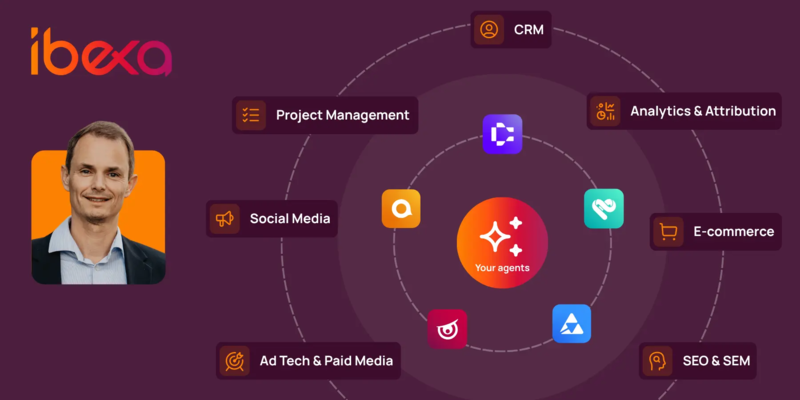
A three-part series by Bertrand Maugain, CEO of Ibexa, on why Ibexa built the Ibexa Agentic Marketing Platform, launched on 23 September 2026. The platform is live today for Early Adopters, and General Access opens on 12 January 2027.
- Part 1: The need for a new operating model for Marketing with AI
- Part 2: From composable DXP to a dedicated Agentic Marketing Platform (coming soon)
- Part 3: The European way to Agentic Marketing (coming soon)
For the role this changes, read our manifesto, The Agentic Marketer.
Part 1: The need for a new operating model for Marketing with AI
On September 23, we launched the Ibexa Agentic Marketing Platform. Before explaining why we built it, let me start by sharing a bit of background information and context related to the environment marketing teams have been operating in over the past three years.
Since 2023, marketing teams have gained powerful AI tools, yet achieving, running and scaling results has become harder. Like many vendors, we began exploring Gen AI in 2023 through targeted investments in our products. Those experiments were useful. But because our technologies span several parts of the marketing stack, we could see the limit of improving one task or one application at a time. The greater opportunity was to help our customers connect the work between them and create more value from the systems they already use.
That conviction led us, 18 months ago, to establish an AI lab focused on investment across our portfolio. Its work combined with each product’s engineering effort has now taken shape as an agentic platform designed to orchestrate marketing beyond any single SaaS product, including our own.
Why make that move? What changes when a software vendor starts building for coordinated outcomes rather than individual applications? And what does it mean for customers, partners and the wider martech industry?
The scale and pace of digital marketing can feel overwhelming right now. But I see a remarkable opportunity within that change: for marketers to do work they could not previously do at scale, for CMOs to reconnect marketing with growth, and for vendors and partners to help shape a better way of working.
Agentic Marketing is not simply a response to disruption. It is an opportunity for our entire industry.
Marketing’s two-sided performance problem
In short: AI has changed the game of engagement and the environment in which marketing must perform. At the same time, it has exposed how fragmented and difficult marketing operations have become.
Externally, the game of engagement has changed
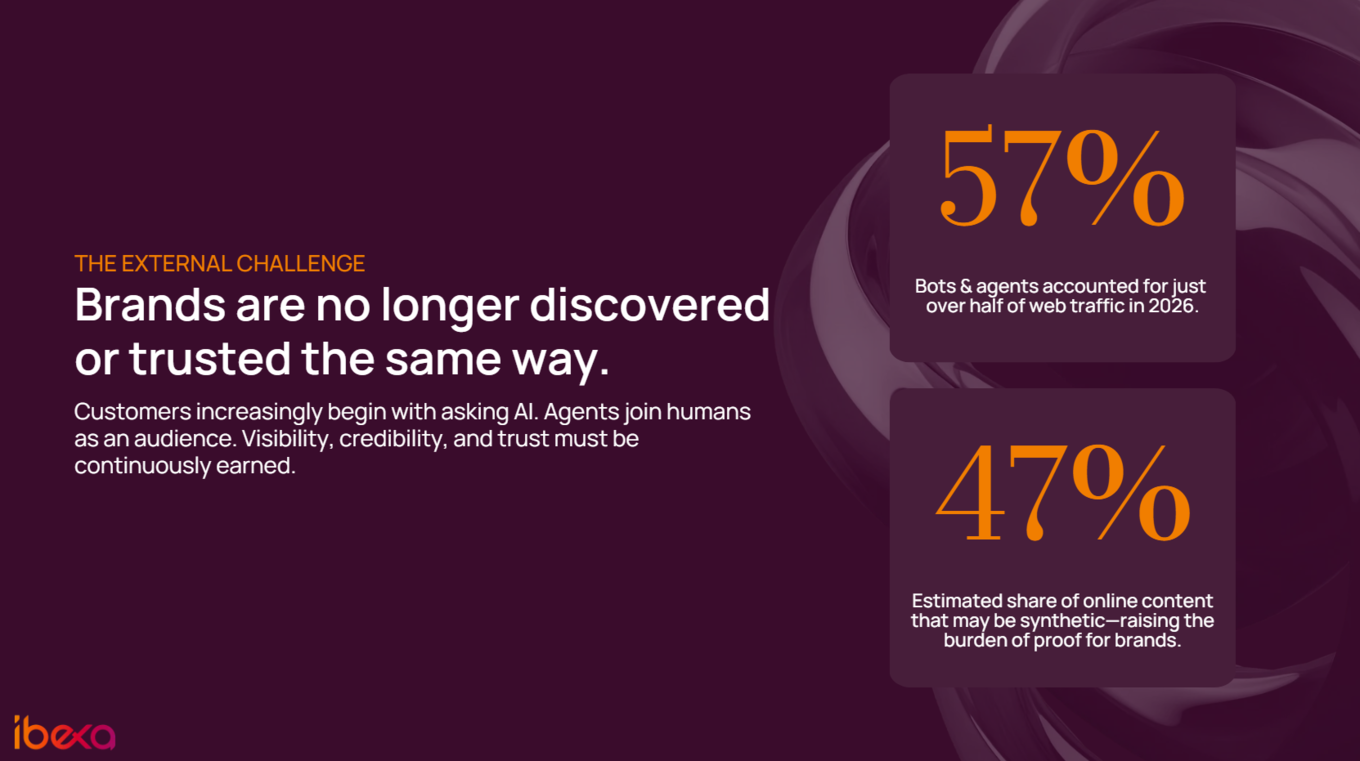
The first challenge is external. The familiar journey from search result to website to conversion is no longer enough to describe how customers discover and evaluate a brand. People increasingly ask AI systems to research, compare and recommend before they visit a website. But this is just the human side of the picture.
Machines also read and interpret the information brands publish. In June 2026, 57% of requests to HTML pages in traffic measured by Cloudflare came from bots or AI agents acting for potential customers. This is, on top of the human consumer behaviour change, another fundamental shift for marketers: brands increasingly need to be useful, understandable and trustworthy to both humans and machines.
Internally, fragmentation has become an AI ROI killer.
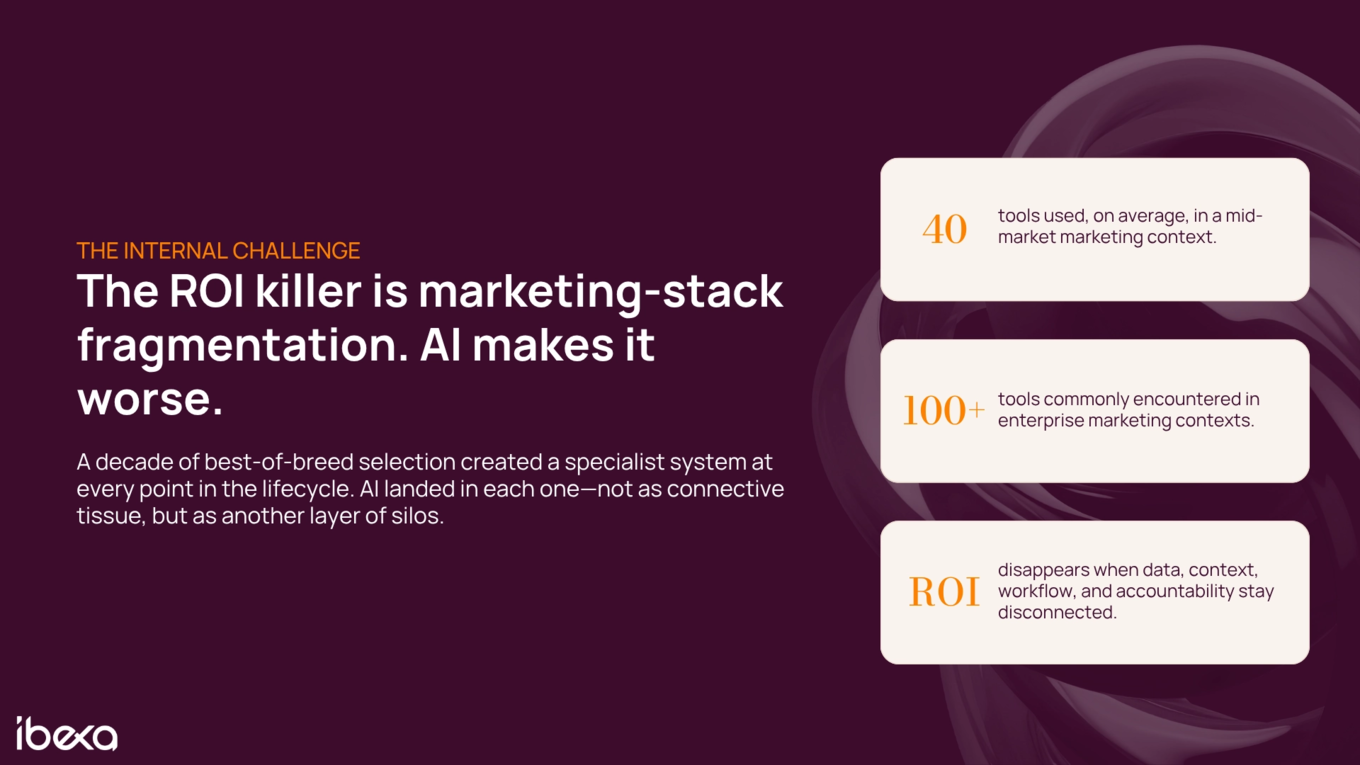
The second challenge is internal. Marketing has acquired specialist systems - in the SaaS / Best-of-Breed era of the last 10 years - for content, product information, customer data, campaigns, analytics and more. Each may perform its own job well. Yet people still spend too much of their time moving information between them, checking which version is correct, reconstructing context and managing decisions across disconnected workflows.
When Gen AI came out we all thought this could be the miraculous glue between all these SaaS Martech tools. It turned out to be the complete opposite: this first wave of AI followed an unfortunate pattern: a copilot inside every application. We gained (more or less) useful assistance, but we did not necessarily gain a better way to run end-to-end marketing. Actually the opposite, AI made the fragmentation worse with hallucinations popping at the frontier between applications and misaligned context. Put simply: fragmentation has been the ROI killer.
Now, let us take the hat of a marketer in this context: performing gets extremely hard. Marketing must respond to a faster, more complex external world while working through an internally fragmented stack.
One operating model for both sides of the equation
It is tempting to treat these as separate problems: improve discoverability outside the business and improve efficiency inside it. I believe that misses the larger opportunity.
I believe that the only way for marketers to respond to the external shift is to shift to Agentic Marketing: to free capacity to do more meaningful work, to find new ways of earning attention and trust, to improve experiences across more journeys and markets, to keep information accurate, and to test where the next growth opportunities will come from. The answer cannot simply be to ask the same teams to produce more assets at greater speed.
Agents can take on repeatable work: monitoring for gaps, gathering information, preparing adaptations, supporting execution and helping teams learn from results. That gives marketers more time for customer understanding, creative judgement, experimentation and commercial decisions. In other words, agentic marketing can expand the organisation’s ability to pursue growth rather than merely accelerate its existing production line.
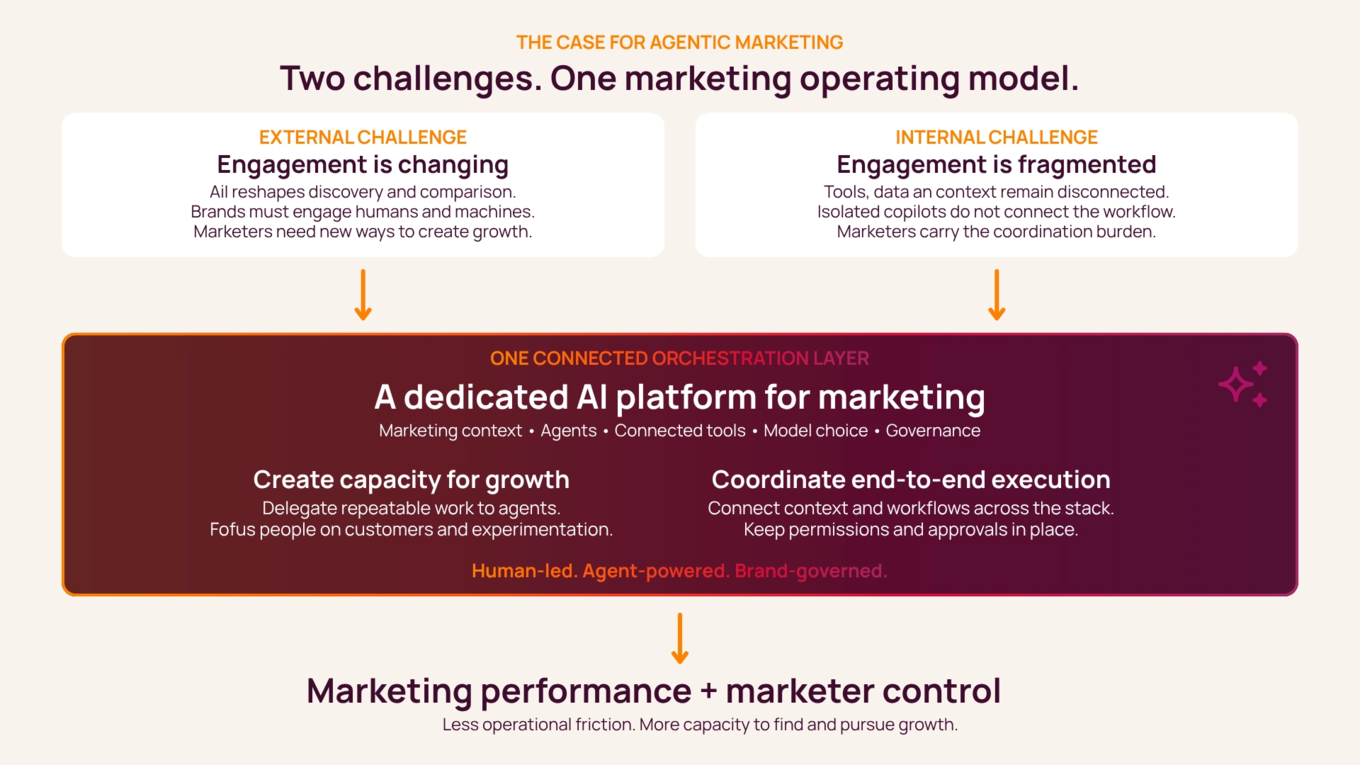
The same shift addresses the internal problem. When agents work across connected tools with the right context and permissions, marketers no longer have to personally carry every piece of information from one system to the next. A campaign can move from product facts to content, audience selection, approval, activation and measurement as a coordinated workflow, with people in control of the decisions that matter.
Agentic Marketing is the connection between the two sides of the equation. Orchestration reduces the friction inside marketing and creates the capacity to compete in a changing market outside it.
That is why I see Agentic Marketing as a new growth engine. It is not about doing the same work with fewer clicks. It is about giving marketing the ability to identify, execute and improve opportunities that were previously too complex or too time-consuming to pursue.
Parts 2 and 3 of this series are coming soon.