



Product & Technology
Orchestration platform: what it is, main types and how to choose
3 min - 26 November 2026
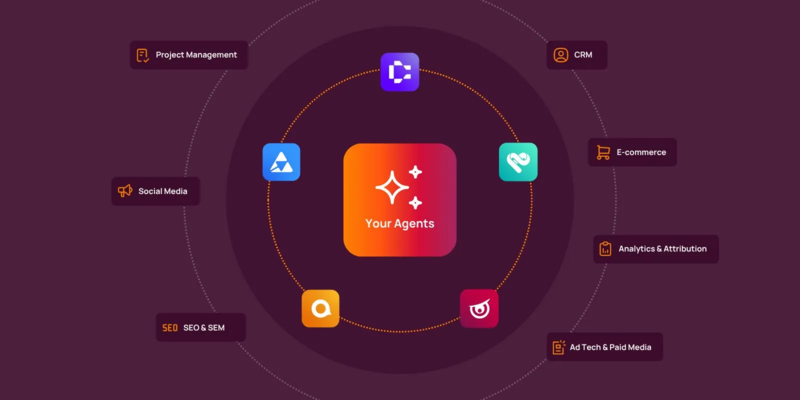
IT teams use the word for containers and cloud resources, data teams for pipelines, AI teams for agents and marketing teams for customer journeys. An orchestration platform is, in all these cases, the layer that coordinates tools, data and tasks so they work together towards an outcome, under shared rules and with a single view of what is happening. What changes is what gets coordinated. This guide explains the main types of orchestration platforms, then focuses on the one marketing teams need: the platform that connects their tools, data and AI agents. For the wider context, see our practical guide to agentic marketing.
What is an orchestration platform?
An orchestration platform is software that coordinates several systems, tasks or agents so they run in the right order, share the information they need and follow common rules. Where automation handles a single task, orchestration manages the whole sequence: what happens, in which tool, in what order and under whose control.
Whatever the field, an orchestration platform does four things:
- Connects: it links the systems involved through connectors and APIs.
- Sequences: it decides what runs when, and what depends on what.
- Governs: it applies rules, permissions and approvals across the whole flow.
- Shows: it gives one view of what is running, what has failed and what needs attention.
Four families of orchestration platforms
The term covers very different products. Knowing which family you need avoids comparing tools that solve different problems.
Infrastructure and cloud orchestration coordinates servers, containers and cloud resources. Kubernetes is the best-known example. Its users are IT operations and DevOps teams.
Data and workflow orchestration schedules and monitors data pipelines and technical workflows, so data moves between systems reliably. Its users are data engineers.
AI agent orchestration coordinates several AI agents within an application, deciding which agent handles which task and how they hand over. Its users are mostly developers building AI products.
Marketing and customer experience orchestration coordinates the tools, data and agents that marketing teams use to reach customers: content, product data, customer data, campaigns and channels. Its users are marketers. This is the family the rest of this guide covers, and the shift it represents is explained in the orchestration era.
What a marketing orchestration platform coordinates
A marketing orchestration platform sits above the tools of the marketing stack and makes them work as one system. It typically coordinates:
- Content: pages, articles and assets managed in a CMS.
- Product information: attributes, descriptions and media managed in a PIM. In an agentic PIM, agents also keep this data complete and consistent.
- Customer data: profiles, consents and behaviours unified in a CDP.
- Engagement: emails, SMS, push and journeys run by a customer engagement platform.
- Data collection: forms, quizzes and interactive campaigns that gather first-party and zero-party data.
- Agents: AI agents that work across these tools, under the same rules and approvals.
The value comes from the connections: a product update reaches every page and campaign, a customer signal adjusts the next message, an agent works from the same data as the team. This marks a change in what digital experience platforms are for, as discussed in redefining the DXP from execution to orchestration.
Unified platform or assembled stack?
There are two ways to orchestrate a marketing stack.
An assembled stack connects best-of-breed tools from different vendors through integrations. It offers freedom of choice, but each connection must be built and maintained, data models differ from one tool to the next and governance is spread across several systems.
A unified orchestration platform brings the main building blocks together, natively connected, with shared data and common governance. It reduces integration work and gives one view of what agents and teams are doing. The risk to check is lock-in: a good unified platform still connects to the tools you already run and lets you adopt its components at your own pace. This is the approach Ibexa took when it brought five martech brands together.
How to choose an orchestration platform
Six criteria help you compare platforms for marketing orchestration:
- Connectors to your existing stack: native integrations and open APIs for the tools you keep.
- Shared data: one customer and product view that every tool and agent reads from.
- AI and agents: the ability to run agents across tools, choose your model and connect through open standards such as MCP.
- Governance and traceability: permissions, approval steps and a log of every action, human or agent.
- Sovereignty and hosting: where data is processed and stored, a point we develop in how sovereignty becomes operational.
- Adoption: an interface marketers can use without depending on IT for every change, and a path to start with one use case.
One platform, every tool working together
An orchestration platform is only as useful as what it connects and how easily your teams use it. For marketing, that means tools, data and agents working together under your rules, with a clear view of everything that runs. See how the Ibexa Agentic Marketing Platform connects the tools you already run and puts agents to work across your stack.